Galvanized Pipe Replacement in Oregon
Brown water at first draw and pressure that collapses when someone else turns a tap on are not quirks of an old house. They are a supply system that has been closing itself off for sixty years.
Common across inner Portland, Salem, Albany and the older valley towns.
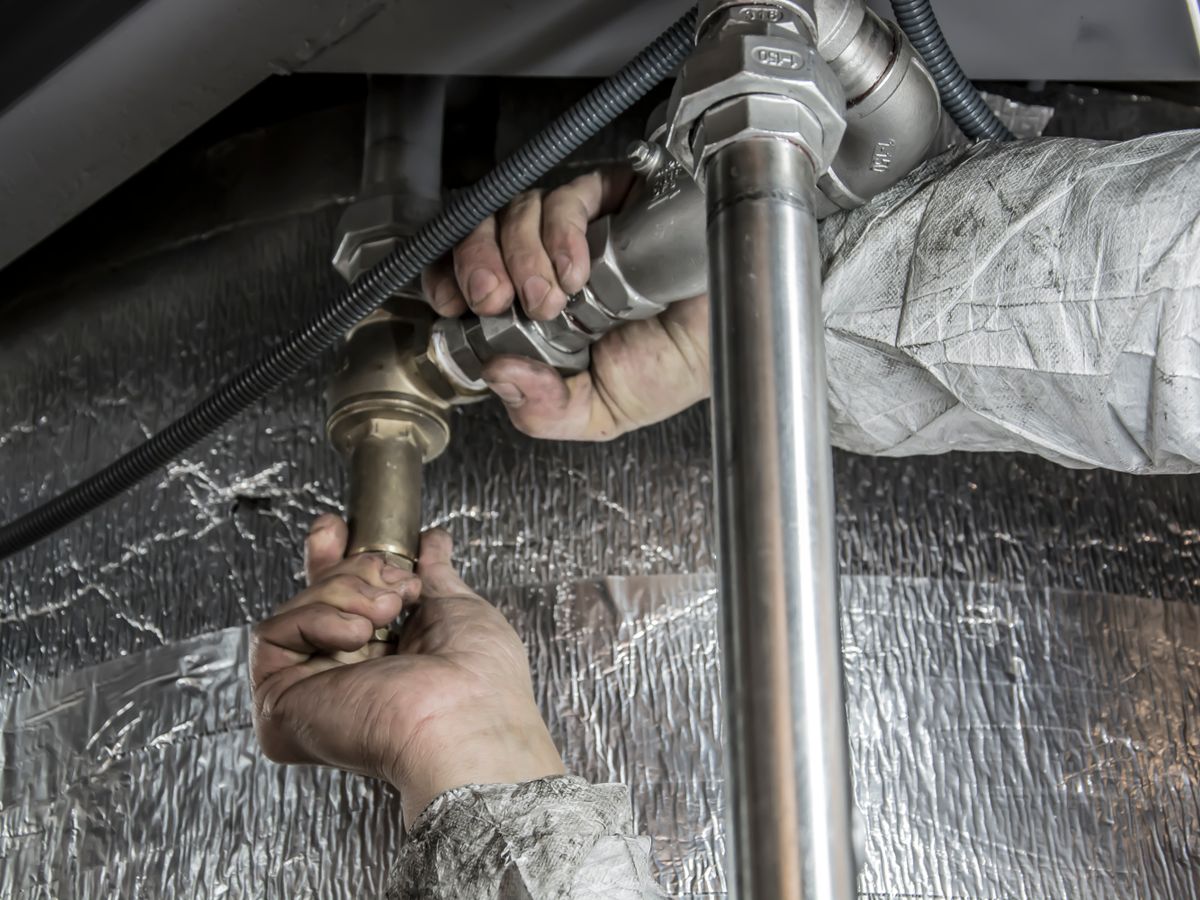
What galvanized pipe is and why it fails
Galvanized pipe is steel with a zinc coating, threaded together at every fitting. It was the standard water supply material in American housing from roughly the 1880s to the 1960s, which means it is in a very large share of Oregon housing stock, inner Portland bungalows and four-squares, older Salem and Albany neighborhoods, Corvallis and Eugene near the campuses, and mill-town housing all over the valley.
The zinc is a sacrificial layer. It corrodes preferentially so the steel underneath does not, and while it lasts the pipe is protected. It does not last indefinitely. Once the coating is consumed, commonly within twenty to forty years depending on water chemistry, the steel begins to rust from the inside.
Rust occupies more volume than the steel it came from, so it does not simply thin the wall; it builds inwards. Deposits accumulate around the internal circumference, roughening the surface and narrowing the bore. On the pipe we cut out of Oregon houses, a three-quarter-inch line frequently has a passage left the diameter of a pencil, sometimes less. Threaded joints corrode fastest, because cutting the thread removed the zinc at the point of greatest stress.
Everything else follows from that geometry. Low flow, discoloured water, and eventually perforation.
The symptoms, in order of appearance
Discoloured water. Brown, orange or yellow at first draw, clearing after a few seconds. Worse after the house has been empty, worse on the hot side, and worse at fixtures at the end of a long run. This is rust leaving the pipe wall.
Falling pressure. Not usually a sudden drop, a decade of gradual decline that people adapt to without noticing. The giveaway is interaction: a shower that loses pressure when the kitchen tap opens, or a toilet flush that changes the shower temperature. That is a bore problem, not a supply problem.
Uneven fixtures. One bathroom noticeably weaker than another, because that branch is further gone.
Staining. Rust marks in basins, baths and toilets, and on laundry.
Pinhole leaks. The late stage. A weep at a threaded joint, or a pinhole in a run, usually somewhere inconvenient. The first leak in a galvanized system is significant not because of the damage it does but because of what it says: the rest of the system is the same age and the same condition.
Rusty water at first draw is the system, not the water supply.
Call Now: 1-866-203-6890Confirming it is the pipe
Before quoting a replacement we establish that galvanized supply is actually what you have and how far gone it is. That is straightforward.
Visible runs in the crawl space, basement or utility area identify the material immediately, galvanized is dull grey steel with threaded fittings, distinct from copper and from any plastic. We check whether the whole system is galvanized or whether part was replaced at some point, which is extremely common: a kitchen remodel in 1985 put copper in one wall and left the rest.
Then we measure static and flowing pressure at a hose bib, and compare pressure with one fixture open against several. A large drop under flow with adequate static pressure is the signature of a restricted bore.
Where there is any doubt, we cut a short section out of an accessible run and show it to you end-on. Nothing in a written report is as persuasive as looking through a pipe and not being able to see daylight.
Two other things we check while we are there: whether the service line from the meter is also galvanized, which is common in houses of this age and is its own job, covered under main water line repair; and whether the drainage is cast iron, since if both are failing, doing them while walls are open is far cheaper than doing them separately.
Why patching makes it worse
Replacing a leaking section of galvanized pipe with a short piece of new pipe is a repair everyone tries once. There are two reasons it disappoints.
The first is that the rest of the system has not improved. You have fixed the place that failed first, in a network where every other joint has the same history. The next failure is typically months, not years, away.
The second is more specific and less obvious: joining new pipe directly to old galvanized creates a dissimilar-metal connection. Copper against steel sets up galvanic corrosion at the junction, which attacks the older metal faster than it was already going. A proper dielectric union slows that, and many patch repairs do not use one. So the repair can accelerate failure immediately adjacent to itself.
This is why we are cautious about quoting spot repairs on galvanized systems. We will do one to stop an active leak; that is an emergency, and the water needs to be back on, but we will be clear that it is a holding measure and price the real job at the same time.
We cut a sample section so you can see the bore for yourself.
Book a WalkthroughFull replacement or phased
Whole-house replacement is the definitive answer: every galvanized supply run replaced, one permit, one round of drywall work, one disruption. Per fixture it is the cheapest way to do it, because access is the expensive part and you pay for access once. See whole-home repiping for how that job runs day to day.
Phased replacement is legitimate and we do a lot of it. Not everyone can absorb a whole-house job in one year, and a sensible sequence gets most of the benefit early.
The order that makes sense: the main horizontal distribution runs and risers first, because they restrict the whole house and they are usually the most corroded; then the bathroom groups, worst first; then kitchen and laundry; then any remaining branch lines. Where a bathroom is due to be remodelled, that branch waits and goes with the remodel.
The one thing we plan for in a phased job is the junctions between new and old, using proper dielectric fittings so the phasing does not create the galvanic problem described above. Done deliberately, phasing is fine. Done as a series of unplanned emergency repairs, it is expensive and it damages what is left.
What replaces it
PEX for most occupied houses. It flexes through existing framing, so the number of wall openings, and therefore the drywall bill, drops substantially. It does not corrode, it handles freezing better than rigid pipe, and it is quieter. Run as a home-run manifold system it also gives stable pressure with multiple fixtures open, which after a galvanized system feels like a different building.
Copper where the walls are already open, or where you prefer it. Rigid, proven, more expensive in both material and labour.
Either way the improvement is immediate and it is the whole point of the job: full-bore pipe with a smooth interior. The pressure and flow you get after replacement is what the house was designed to have.
What drives the cost
Fixture count, number of bathrooms and number of storeys set the scale. Then wall construction, plaster and lath, common in the houses that have galvanized, costs more to open and considerably more to make good than drywall. Then how much routing can run through an accessible crawl space or attic instead of through finished walls.
Houses on a slab, or with no crawl space and no attic access, are the most expensive per fixture because everything has to be rerouted through the structure.
Permits, inspection and drywall restoration are in our quotes. Phased work is quoted per phase with the whole-house figure shown alongside, so you can see exactly what the phasing costs you in total; it is usually more, and you should be able to see how much before you choose.
Phased replacement is legitimate, ask how we sequence it.
See Phased OptionsServices that often go with this one
- Whole-home repiping
- Main water line repair
- Water pressure regulator
- Cast iron drain replacement
- Leak detection
- Water filtration & treatment
Where we cover
Available in all seven regions, 155 Oregon communities.
Galvanized pipe, answered
The rust itself is chiefly an aesthetic and taste problem rather than a health one. The genuine concern in very old systems is that galvanized pipe of certain eras was manufactured with lead in the zinc coating, and lead solder or lead service components may also be present. If that is a concern, have the water tested, and note that replacement removes the question entirely.
Commonly forty to seventy years before it becomes a problem, depending on water chemistry and pressure. Most Oregon galvanized systems still in service are past that window, which is why we see so many of them at the end of their life at once.
No. Descaling exists for some materials, but on galvanized it removes what little wall integrity is left behind the rust. The rust is not a coating on a good pipe; it is what the pipe has turned into.
You can, and it helps a little if those are the main distribution runs. But the branches inside the walls are the same age, and a partial job needs proper dielectric junctions to avoid accelerating corrosion where new meets old. We will sequence it deliberately if you want to phase.
If the restriction is in the house piping, dramatically; this is the most common reason people tell us the house feels different afterwards. If the service line from the meter is also galvanized, or if a pressure regulator has failed, those need addressing too, and we check both.
Galvanized supply is something inspectors flag and buyers price in. A documented, permitted replacement removes that deduction and the warranty transfers the conversation from a risk to a feature. Keep the paperwork.
Bring another quote and we will compare scope honestly.
Ask About Your HouseLook through a cut section once and the decision makes itself
We will walk the house, measure the pressure drop under flow, and show you the inside of your own pipe. Then you get a written quote for the whole job and for a phased version.
Every region, though the housing that has it is mostly west of the Cascades.
Call 1-866-203-6890